
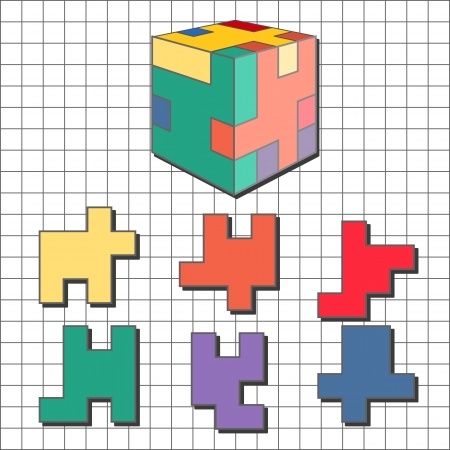
Non-verbal reasoning comprises a series of tests which use pictures to test logic. I shall outline a number of such tests, although my list will not be exhaustive:
Similarity
These tests often include four or five picture which have some similarity. The candidate must identify the similarity and then find it in one of five options.
Difference
If a nets with pictures on its faces are presented, it is likely the candidate will be required to identify one out of five options which cannot possibly be made from the net given. The answer should be deduced from knowing which squares of the net are placed together and what the shape will look like from different angles. The best way I like to address this type of question is to look for faces which will be opposite each other is the first net, and then look for these faces beside each other is the nets to select.
Find the shape
At least for me, this is one of the easiest aspects of NVR. Just look at the shape given, and find it within one of five combination of shapes given. It could be the same way up, or sideways, or sometimes even diagonally.
Sequences
Often a series of four or five pictures will be presented. The candidate has to identify from a selection which shape should come next, or mid-sequence, depending on where the gap is. Sequences are more difficult when there is more detail in them and to address this, candidates should look at one aspect at once and eliminate impossible answers in turn. Often sequences will involve a shape in the picture being added or subtracted, dispersed, moved vertically or horizontally, or rotated.
Relationships
Two shapes will be given which relate to each other but have differences. The candidate must work out what happened to the first shape to turn it into the second shape. Sometimes it will have been reflected; sometimes broken (dotted/dash) lines may become unbroken; sometimes shading will change; features in corners will swop corners; sometimes shapes will overlap, separate or change size for example. Once the relationship between the first two shapes is identified, the same changes should be applied to a third shape to give the answer.
Fill in the box
A square of 2×2 or 3×3 will be presented with pictures in each square. If you look at each row or column in turn, you will notice common similarities. For example, 2 out of 3 shapes presented in a row may be spotted. The right hand side may be a reflection of the left hand side. These questions get more complex when they contain more features and the best way I like to work out the missing answer is to draw the right option in the empty box. This is best done by focusing on one aspect at a time.
Codes
Four or five pictures are presented in a drawn box. In each box there is a code letter at the top and at the bottom. Candidates must work out what each letter represents in the shape and then apply it to another shape. Often the code letter will stand for a shape, shading, direction of smaller shapes or size.
Advise: Beware of answers offered to catch you out. Look closely at the direction of the diagonal. If two answers appear the same, identify the difference between them before you make your decision.
 About Sara Connerton